Monday, December 9, 2013

Employment Blues

Last Friday's unemployment report was slightly better than most analysts had expected.  The markets initially rallied sharply, but most indices ended the day essentially unchanged.

The official unemployment rate now stands at 7%, which is the lowest level in 5 years.  Here's what the New York Times reported:

Employers have hired at least 200,000 workers in three of the last four months, including 203,000 in November. By contrast, as recently as July, when the economy seemed stuck in yet another summer swoon, only 89,000 new jobs were created...

 The 7 percent unemployment rate last month — down from its most recent peak of 10 percent in October 2009 — is the best reading since President Obama took office, providing one bright spot for a White House beleaguered on many other fronts. The unemployment rate was 7.3 percent in December 2008, the month before Mr. Obama was inaugurated. 

http://www.nytimes.com/2013/12/07/business/economy/us-economy-adds-203000-jobs-as-unemployment-falls-to-5-year-low.html?_r=0

However, relative to history, unemployment rates are unacceptably high.

I started After the Music Stopped: The Financial Crisis, the Response and the Work Ahead  (New York: The Penguin Press, 24 Jan. 2013. ISBN 978-1594205309) last week. 

Written by former Federal Reserve Vice Chairman Alan Blinder, the book has been cited as one of the best reviews of the 2007 - 2009 credit crisis. 

So far, at least, I agree with the critics.

One of the points that Blinder makes early in his book is the tepid state of the current economic recovery.  While the stock market has doubled from the March 2009, the economic recovery has been incredibly weak by historic standards.

Here's an excerpt from Blinder's book talking about unemployment (emphasis his):

During the quarter century from February 1984 through January 2009, Americans never witnessed an unemployment rate as high as 8 percent for even a single month.  An entire generation entered the labor force and worked for decades without ever experiencing an unemployment rate as high as the lowest rate we had from February 2009 through August 2012....even unemployment rates above 7 percent were rare during this twenty-five year period.

So with Blinder's book in mind, I turned to the Federal Reserve of St. Louis to get more information on the current employment situation. 

Unfortunately, I think I am seeing Blinder's point.

Look, for example, at the size of the total civilian workforce.  Yes, it is up considerably from the lows five years ago, but still slightly lower than it was in 2007:
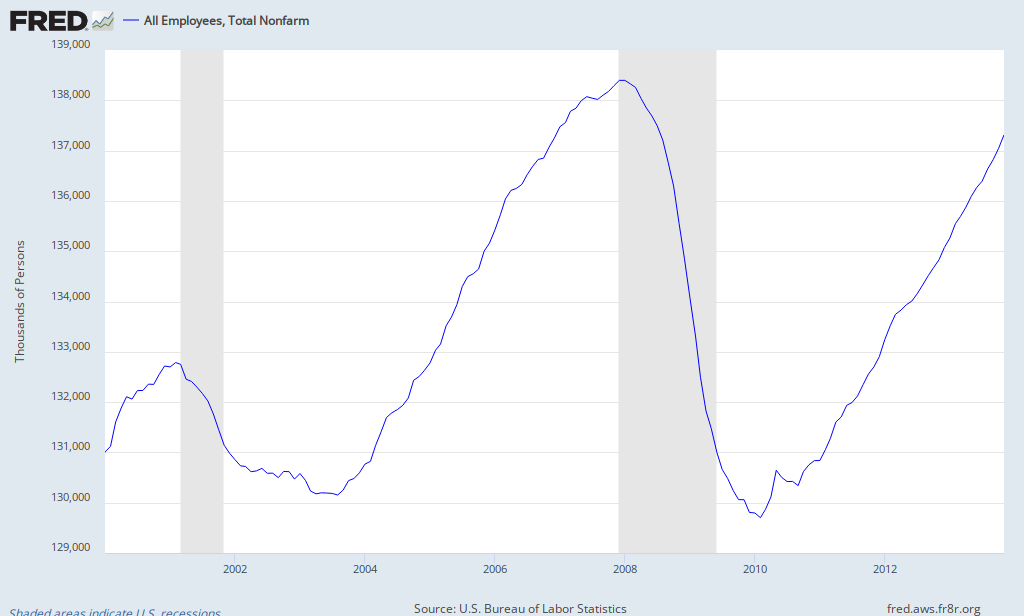
FRED Graph


Labor participation rates are considerably lower as well.  Even for workers with college degrees - normally considered the most "employable" - are considerably lower than a generation ago:
Graph of Civilian Labor Force Participation Rate - Bachelor's Degree and Higher, 25 years and over


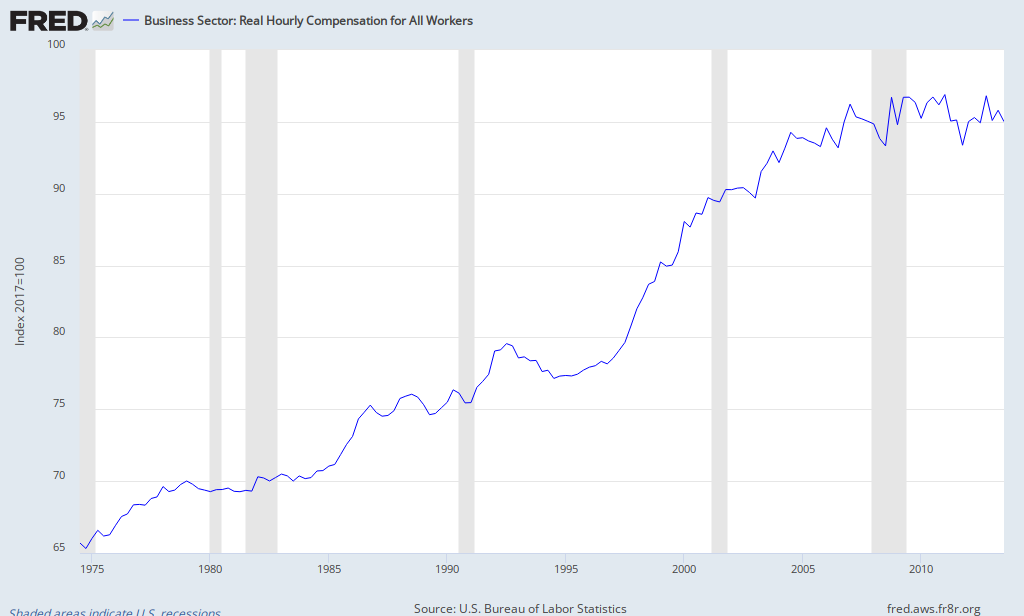
Not surprisingly, then, real income growth remains anemic:
FRED Graph

The question that Wall Street economists are debating is when the Fed begins to "taper", i.e., reduce its presence in the credit markets.

Based on the current employment data, this date might be further away than  many anticipate.


Friday, December 6, 2013

Peter Lynch on Investing


Investment legend Peter Lynch appeared was interviewed by Charlie Rose earlier this week.

Peter Lynch, of course, produced one of the best investing records of our generation when he ran the Magellan Fund for Fidelity.  From 1977 to 1990 Magellan produced an annual compound return of over +29% per annum.

Lynch retired in 1991 to focus more time on his family and philanthropic activities.  However, he still remains one of the most astute and thoughtful investment voices in the business.

The interview runs almost 24 minutes, but it is well worth your time.

Lynch was always a proponent of "invest in what you know".  As he discusses in the interview, if you truly understand the business any declines in prices are viewed as opportunities rather than cause for concern.

He dismisses any idea that successful investing in stocks can be gleaned from a careful reading of economic data - focusing on company fundamentals is the path for success.


Towards the end of the interview Rose asks Lynch for his views on the current market. 

His answer was fairly simple:  stock prices follow earnings, and earnings should continue to grow at +7% to 8% for the next few years.  While he said he had no idea what the market would do in the next couple of years, investors with a longer time horizon would be well-served to simply stay invested.

Thursday, December 5, 2013

A "Taper" In a Teapot?

Stephen Antczak of Citigroup is out with an interesting research piece this morning on tapering.

Market participants have been worried for most of the year about what will happen when the Fed gradually starts withdrawing (i.e.,"tapering") its active in the credit markets.

In June of this year, for example, interest rates jumped higher, and the stock market moved lower, when Fed Chair Bernanke suggested that the Fed might start gradually reducing its bond buying program.  Although Bernanke later claimed that his remarks were misinterpreted, many investors viewed the negative market reaction in June as a harbinger of things to come.

Antczak gives three reasons that Citi believe that fears over tapering are overblown:
  1. Net Treasury issuance in 2014 is projected to be at its lowest level since 2008 as the federal deficit gradually declines.  Meanwhile, $1.4 trillion in Treasury debt is set to mature next year, and it is likely that a large chunk of these funds will be plowed back into the government bond market;
  2. The amount of attention to tapering has dramatically increased in recent months.  Citi's research indicates that nearly 300 stories a day have been written on the market effect of tapering compared to almost none at the beginning of the year.  With so much attention being paid to the issue, perhaps market prices already reflect the beginning of tapering;
  3. Following on point 2, Citi looked back at prior periods when interest rates on Treasury debt moved sharply higher. They found that corporate bond yields did not move up nearly as much as Treasury yields, meaning that the net effect of a rise in government interest rates would not be felt as much by corporate bond investors even if rates rise when the Fed begins to taper.
 The more I study this issue, the more I am inclined to agree with Citi.  Perhaps the initial reaction to a Fed tapering announcement might be negative, but the Fed will probably not move until the economy shows solid signs of improvement. 

In other words, if the Fed is beginning to leave the credit markets, corporate America is probably chugging along with enough steam to generate earnings growth that will support current market levels.

For your reference, I last wrote about tapering at the end of October 2013. I referenced an interview with Nobel laureate Eugene Fama who also believed that tapering will essentially be a non-issue.  Here is an excerpt from my Random Glenings piece dated October 30, 2013, with the link below:

Nobel Prize winner Eugene Fama was interviewed by CNBC's Rick Santelli earlier this week.
In his usual hysterical fashion, Santelli was trying to get Fama to say that interest rates were set to soar once the Fed ends its "Quantitative Easing" (QE) program.

Problem was, Fama doesn't believe it.

As you will see from the interview, Fama notes that he has been doing research on the possible effects on the credit markets once the Fed starts reducing its holdings of longer term Treasurys.

Fama doesn't believe the markets will be as roiled as Wall Street believes once the Fed stops buying.

He points out that the purchases of Treasurys have been financed by the Fed's borrowing activities in the short term market.  Thus, the $4 trillion in Treasurys that it holds have been financed by $4 trillion in borrowing.  Reducing one side of the ledger also reduces the other side, so the net effect should be relatively neutral.


http://randomglenings.blogspot.com/2013/10/eugene-fama-on-fed-tapering-its-net.html

Wednesday, December 4, 2013

Waiting for Godot: Timing the Next Market Correction

I've been having numerous conversations with clients about the stock market this week.

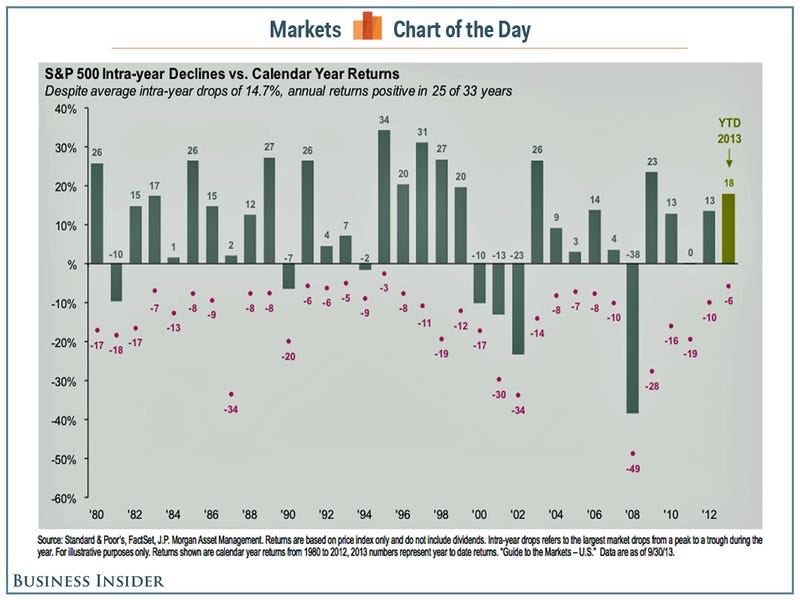
Most people are aware that stock markets will "correct" over time. This is not a particularly bold prediction. J.P. Morgan's Paul Quinsee pointed out to clients recently that this year is unusual is the lack of a serious market decline at any point during this year. 

Here's a chart he prepared which showed that although markets typically experience some turbulence, returns have been mostly positive for the past three decades:
cotd drawdowns
source: http://www.businessinsider.com/stock-market-intra-year-decline-chart-2013-12

Longer term, however, is the question of whether the market is seriously overvalued after its recent run.

As I have been writing in numerous posts over the past couple of months, most investors are uneasy with the disconnect between a sputtering economy and a roaring stock market. While it is only anecdotal evidence, there is very little sign of "irrational exuberance", at least as far as I can tell.

Bears will point to the very high multiples accorded to recent internet company valuations.  However, for the overall market, it is hard to make a case that most stocks are overvalued.

Stocks on an absolute basis relative to history are probably no better than reasonably valued.  Here for example is one historic chart courtesy of analyst Doug Short:

Source: http://www.advisorperspectives.com/dshort/updates/PE-Ratios-and-Market-Valuation.php

 
I continue to believe that the clues to the next serious market problem will be found in the bond market.

Most of the serious bear markets over the past few decades have had their origins in the credit markets.  When credit becomes tight - either through central bank activity or just general market fears - business activity grinds to a halt, and brings down earnings.

We are far from a tight credit markets today.  Corporate borrowers continue to find a ready group of buyers for new bond issues, almost regardless of credit quality.  Municipal bonds too are in strong demand, particularly for shorter maturity paper.

I fully expect that we will see a market correction in the coming months, but only because stocks have been on such a roaring uptrend in 2013.

Tuesday, December 3, 2013

The Great Expansion

FRED Graph
source:  Federal Reserve Bank of St. Louis
 
In my memory, 1974 was not a particularly happy year.

President Nixon resigned in August 1974 in the aftermath of the Watergate scandal.  He left behind a country that was about to see its decades-long military effort in Vietnam collapse.  Inflationary pressures were continuing to build, pushing prices ever higher.  The mood of the country was sour.

Yet an article published over last weekend contended that 1974 was actually a year that U.S. workers should celebrate.

Harold Myerson wrote a long article for American Prospect that pointed out that 1974 marked the end of a long-term trend that had started after World War II which had seen a steady rise in middle class wages and living standards.

The upper income class had not benefited to the same degree as the middle class, which meant that the wage differential between the higher paid and lower paid workers had narrowed considerably:

Since 1947, Americans at all points on the economic spectrum had become a little better off with each passing year. The economy’s rising tide, as President John F. Kennedy had famously said, was lifting all boats. Productivity had risen by 97 percent in the preceding quarter-century, and median wages had risen by 95 percent. As economist John Kenneth Galbraith noted in The Affluent Society, this newly middle-class nation had become more egalitarian. ...Economists have dubbed the period the “Great Compression.”

However, as Myerson writes, 1974 marked the end of the improvement in real wage gains for most Americans.  For the next 40 years, wage and wealth gaps would widen enormously:

Then, it all stopped. In 1974, wages fell by 2.1 percent and median household income shrunk by $1,500. To be sure, it was a year of mild recession, but the nation had experienced five previous downturns during its 25-year run of prosperity without seeing wages come down.

What no one grasped at the time was that this wasn’t a one-year anomaly, that 1974 would mark a fundamental breakpoint in American economic history. In the years since, the tide has continued to rise, but a growing number of boats have been chained to the bottom. Productivity has increased by 80 percent, but median compensation (that’s wages plus benefits) has risen by just 11 percent during that time. The middle-income jobs of the nation’s postwar boom years have disproportionately vanished. Low-wage jobs have disproportionately burgeoned. Employment has become less secure. Benefits have been cut. The dictionary definition of “layoff” has changed, from denoting a temporary severance from one’s job to denoting a permanent severance.

http://prospect.org/article/40-year-slump#.UpnnWfSn9h4.twitter

In other words, the "Great Compression" of the post-war period has turned into the "Great Expansion".  Wage and wealth gains have been largely concentrated in the upper income category, while most workers have not participated.

In a fairly heartless fashion, the stock market has apparently taken note of the lack of wage growth and moved steadily higher.  Investors are cheered by the fact that while top line growth has been meager, margins have remained at record highs, allowing for profits to continue growing.

Here's what Bloomberg reported this morning:

The weakest employment recovery in seven decades is proving a boon to equity markets.
 
Five years into a rally that has restored $14 trillion to share prices, U.S. payrolls remain 1.5 million below the level in 2008, according to data compiled by Bloomberg. Resistance to hiring from ConocoPhillips to Walt Disney Co. (DIS) will help push Standard & Poor’s 500 Index profit margins above 10 percent next year, the highest ever, data show. Below-average employment was cited last month by Federal Reserve chairman nominee Janet Yellen as the biggest obstacle to raising interest rates. 

While American workers struggle, investors are benefiting as expense reductions and record low borrowing costs drive profits and underpin a 167 percent advance in the S&P 500 over the past 57 months. To bulls...{this means that} equities will keep rallying as long as the Fed remains more concerned about employment than inflation. 

http://www.bloomberg.com/news/2013-12-02/bull-market-shows-no-sign-of-death-with-yellen-support.html
 

Monday, December 2, 2013

Jeff Bezos on CBS's 60 Minutes - 12/1/13

Why Amazon Has Been So Successful


I just finished reading The Everything Store: Jeff Bezos and the Age of Amazon.

Written by Bloomberg technology reporter Brad Stone, the book is a terrific read.

While some have disputed some of Stone's facts (most notably, Jeff Bezos's Mackenzie has written a very negative review which is posted on Amazon), the overall story is an incredible one. Little wonder that the Financial Times named it "Business Book of the Year for 2013".


The focus of the book is on Jeff Bezos and his relentless drive to have his company succeed in becoming the largest internet retailer in the world.  While Bezos is portrayed as a demanding boss, he is also given well-deserved credit for being a true visionary in seeing the opportunities in internet retailing.

Bezos is compared to a chess player who plays a number of different games at the same time.  He is constantly thinking of the next step necessary to keep ahead of the competition and add more sales to his multi-billion dollar company.

I was reminded of this last night, when the CBS news program 60 Minutes carried a feature story on Amazon which featured an interview with Bezos.

The major news story from the piece was the announcement that Amazon is considering using small drones to deliver packages to customers.  In the interview Bezos argues that the day when a small package arrives at your door could happen as soon as 2015.

http://www.cbsnews.com/test

Cyberspace instantly went crazy.  The idea of small aircraft whirring around the neighborhood with five pound packages to be delivered seems too implausible to be believed.  Moreover, as Bezos himself acknowledges in the interview, the FAA has to date not been all that keen on allowing unmonitored aircraft into the air.

However, it could also be that Bezos knows this all too well. Perhaps he was using the 60 Minutes appearance to promote Amazon for free at the beginning of the holiday shopping season.  In addition, by highlighting such a futuristic vision, he could very well have been trying to change the image of Amazon from a huge on-line retailer to a cool technology company.

The blog Business Insider (partly, by the way, by one Jeff Bezos) seems to agree with my assessment that perhaps Bezos - in typical fashion - was thinking far ahead of delivery drones:


The fact is, there is a very good chance that, last night, Amazon "announced" a service that will never exist in reality.

Why did Amazon do that?

The answer is free advertising. Even better: free advertising the night before the biggest e-commerce shopping day of the year, Cyber Monday.

How much was that free advertising worth?

"60 Minutes" gave more than 15 minutes to its Amazon story. A 30-second spot during the 7 p.m. show usually costs just over $100,000.

If you figure Amazon got 30 30-second commercials' worth of time, you can estimate that it got about $3 million worth of "earned" media. 

But $3 million is probably a very low estimate. That's just the cost Amazon would have had to pay to reach "60 Minutes'" 13 million viewers. Thanks to all the coverage Amazon Prime Air has gotten in other outlets, many more millions of people are talking about the company today.

In short, you don't get to be Jeff Bezos without being pretty smart.