Showing posts with label Fed Policy. Show all posts

Monday, December 9, 2013

Employment Blues

Last Friday's unemployment report was slightly better than most analysts had expected.  The markets initially rallied sharply, but most indices ended the day essentially unchanged.

The official unemployment rate now stands at 7%, which is the lowest level in 5 years.  Here's what the New York Times reported:

Employers have hired at least 200,000 workers in three of the last four months, including 203,000 in November. By contrast, as recently as July, when the economy seemed stuck in yet another summer swoon, only 89,000 new jobs were created...

 The 7 percent unemployment rate last month — down from its most recent peak of 10 percent in October 2009 — is the best reading since President Obama took office, providing one bright spot for a White House beleaguered on many other fronts. The unemployment rate was 7.3 percent in December 2008, the month before Mr. Obama was inaugurated. 

http://www.nytimes.com/2013/12/07/business/economy/us-economy-adds-203000-jobs-as-unemployment-falls-to-5-year-low.html?_r=0

However, relative to history, unemployment rates are unacceptably high.

I started After the Music Stopped: The Financial Crisis, the Response and the Work Ahead  (New York: The Penguin Press, 24 Jan. 2013. ISBN 978-1594205309) last week. 

Written by former Federal Reserve Vice Chairman Alan Blinder, the book has been cited as one of the best reviews of the 2007 - 2009 credit crisis. 

So far, at least, I agree with the critics.

One of the points that Blinder makes early in his book is the tepid state of the current economic recovery.  While the stock market has doubled from the March 2009, the economic recovery has been incredibly weak by historic standards.

Here's an excerpt from Blinder's book talking about unemployment (emphasis his):

During the quarter century from February 1984 through January 2009, Americans never witnessed an unemployment rate as high as 8 percent for even a single month.  An entire generation entered the labor force and worked for decades without ever experiencing an unemployment rate as high as the lowest rate we had from February 2009 through August 2012....even unemployment rates above 7 percent were rare during this twenty-five year period.

So with Blinder's book in mind, I turned to the Federal Reserve of St. Louis to get more information on the current employment situation. 

Unfortunately, I think I am seeing Blinder's point.

Look, for example, at the size of the total civilian workforce.  Yes, it is up considerably from the lows five years ago, but still slightly lower than it was in 2007:
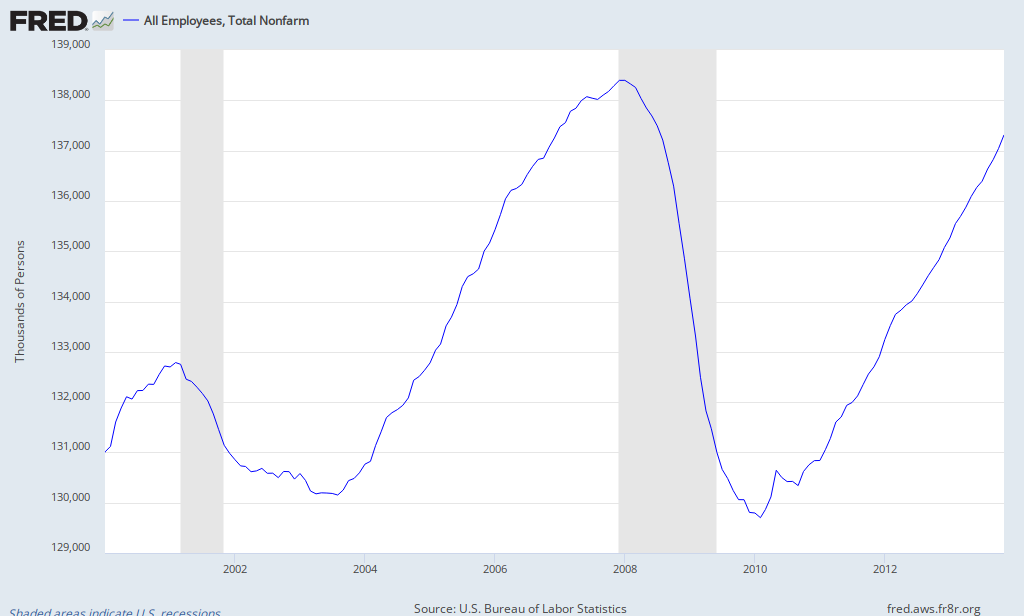
FRED Graph


Labor participation rates are considerably lower as well.  Even for workers with college degrees - normally considered the most "employable" - are considerably lower than a generation ago:
Graph of Civilian Labor Force Participation Rate - Bachelor's Degree and Higher, 25 years and over


Not surprisingly, then, real income growth remains anemic:
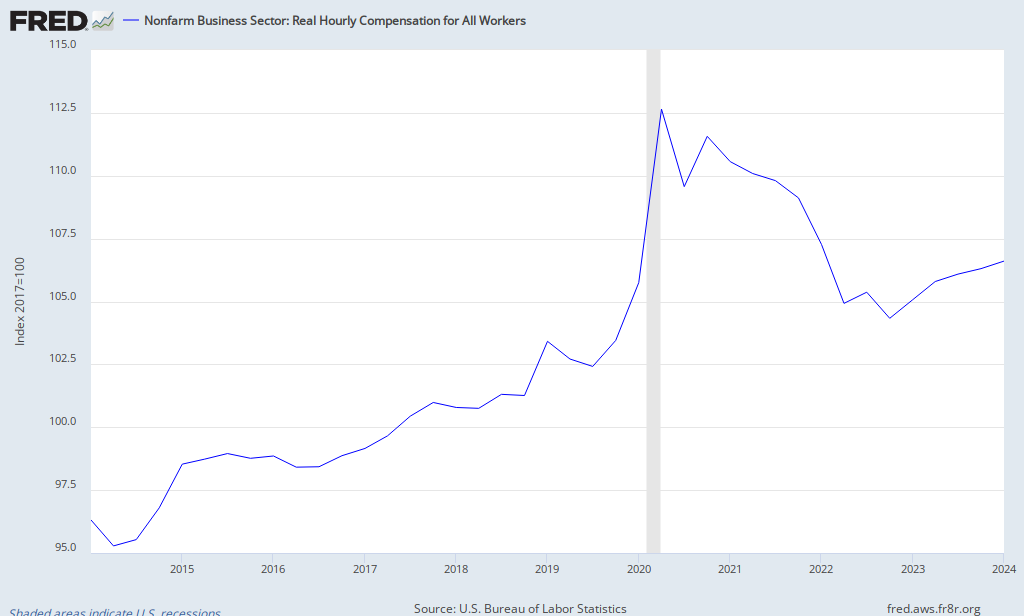
FRED Graph

The question that Wall Street economists are debating is when the Fed begins to "taper", i.e., reduce its presence in the credit markets.

Based on the current employment data, this date might be further away than  many anticipate.


Thursday, December 5, 2013

A "Taper" In a Teapot?

Stephen Antczak of Citigroup is out with an interesting research piece this morning on tapering.

Market participants have been worried for most of the year about what will happen when the Fed gradually starts withdrawing (i.e.,"tapering") its active in the credit markets.

In June of this year, for example, interest rates jumped higher, and the stock market moved lower, when Fed Chair Bernanke suggested that the Fed might start gradually reducing its bond buying program.  Although Bernanke later claimed that his remarks were misinterpreted, many investors viewed the negative market reaction in June as a harbinger of things to come.

Antczak gives three reasons that Citi believe that fears over tapering are overblown:
  1. Net Treasury issuance in 2014 is projected to be at its lowest level since 2008 as the federal deficit gradually declines.  Meanwhile, $1.4 trillion in Treasury debt is set to mature next year, and it is likely that a large chunk of these funds will be plowed back into the government bond market;
  2. The amount of attention to tapering has dramatically increased in recent months.  Citi's research indicates that nearly 300 stories a day have been written on the market effect of tapering compared to almost none at the beginning of the year.  With so much attention being paid to the issue, perhaps market prices already reflect the beginning of tapering;
  3. Following on point 2, Citi looked back at prior periods when interest rates on Treasury debt moved sharply higher. They found that corporate bond yields did not move up nearly as much as Treasury yields, meaning that the net effect of a rise in government interest rates would not be felt as much by corporate bond investors even if rates rise when the Fed begins to taper.
 The more I study this issue, the more I am inclined to agree with Citi.  Perhaps the initial reaction to a Fed tapering announcement might be negative, but the Fed will probably not move until the economy shows solid signs of improvement. 

In other words, if the Fed is beginning to leave the credit markets, corporate America is probably chugging along with enough steam to generate earnings growth that will support current market levels.

For your reference, I last wrote about tapering at the end of October 2013. I referenced an interview with Nobel laureate Eugene Fama who also believed that tapering will essentially be a non-issue.  Here is an excerpt from my Random Glenings piece dated October 30, 2013, with the link below:

Nobel Prize winner Eugene Fama was interviewed by CNBC's Rick Santelli earlier this week.
In his usual hysterical fashion, Santelli was trying to get Fama to say that interest rates were set to soar once the Fed ends its "Quantitative Easing" (QE) program.

Problem was, Fama doesn't believe it.

As you will see from the interview, Fama notes that he has been doing research on the possible effects on the credit markets once the Fed starts reducing its holdings of longer term Treasurys.

Fama doesn't believe the markets will be as roiled as Wall Street believes once the Fed stops buying.

He points out that the purchases of Treasurys have been financed by the Fed's borrowing activities in the short term market.  Thus, the $4 trillion in Treasurys that it holds have been financed by $4 trillion in borrowing.  Reducing one side of the ledger also reduces the other side, so the net effect should be relatively neutral.


http://randomglenings.blogspot.com/2013/10/eugene-fama-on-fed-tapering-its-net.html

Wednesday, August 21, 2013

Interest Rates, Mortgage-Backed Securities and the Negative Convexity Trade

 Graph of 30-Year Conventional Mortgage Rate


I apologize in advance for the somewhat wonkish title and substance of this post.  However, today's subject is getting a lot of buzz among fixed income professionals, so I thought you might be interested.

Although some of the features of mortgage-backed securities (MBS) make them an attractive asset class for many bond investors, they also have some unique characteristics that present a challenge for fixed income managers.

MBS are fixed income securities that are backed by home mortgages which all pay the same rate of interest.  The vast majority of MBS are guaranteed for timely payment of principal and interest by the quasi-government agencies Fannie Mae and Freddie Mac.  MBS guaranteed by Ginnie Mae carry the full guaranty of the United States Treasury.

As anyone who has ever had a mortgage in the U.S. knows, homeowners have the right to refinance their mortgages if interest rates fall.  On the other hand, if mortgage rates rise, the homeowner's rate will not change (unless they have a adjustable rate mortgage).

MBS tend to trade at a higher yield than straight Treasury or Federal agency debt for a couple of reasons.

First, they are relatively cumbersome instruments:  every month, payments of principal and interest are passed through to the security holder.

Second, unlike conventional bonds, the interest rate sensitivity of MBS rises as interest rates increase, but declines when rates fall.

This latter point is probably best illustrated by an example.  Say you purchase an MBS that is secured by fixed rate home mortgages all paying a 5% interest rate.  If rates go to 3%, many homeowners will find it attractive to refinance their existing mortgage.  When this happens, the holder of the MBS will receive their principal back at par, even though they would prefer to keep receiving the higher rate.

On the other hand, if mortgage rates go to, say, 8%, homeowners will be perfectly content to hold onto their 5% mortgage, even though in this case the MBS investor would rather get their money back and invest at higher yields.

This "heads I lose, tails you win" challenge for MBS holders is one of the primary reasons that they offer better yields than other fixed income securities with similar credit characteristics.

MBS holders bear all of the interest rate risk, since their bonds are repaid at a time that is the least attractive from their perspective or do not get paid back when rates are rising.

In mathematical terms, this unattractive feature of MBS is called "negative convexity".

Without going into specifics (I can hear you breathing a sigh of relief), this simply means that MBS interest rates moves in the opposite direction of what would be preferable from an investment perspective.

OK, if you've made it this far, now we come to the reason I went through all of this.

There are $4.8 trillion of MBS outstanding.  Traditionally these have been held by commercial banks, mutual funds and insurance companies, although investment banks routinely hold them in the course of their normal trading activity.

A number of large MBS investors try to hedge the interest rate sensitivity by either selling longer-dated Treasury securities (when rates are rising) or buying Treasurys (when rates are falling).  Because the MBS market is so large (about 29% of the taxable bond market), any large movements in interest rates can be magnified by hedging activity.

Interest rates have been steadily rising since the end of April of this year:


Rates have been rising for a myriad of reasons, but to someone trying to hedge their MBS portfolio this is a real problem.

As yields have risen, the interest rate sensitivity (i.e. duration) of the MBS market has increased, and prices have been falling. As rise have risen the more the likely further MBS price declines are in store, so dealers will need to sell more Treasury positions to reduce their interest rate exposure.

As you might imagine, Wall Street is very concerned about all of this.  Selling of Treasury securities by Chinese and Japanese investors hit record levels earlier this summer.  If the MBS community needs to sell Treasurys as well, this will further push interest rates higher, and bond prices in general will continue to fall.

One of my colleagues reported yesterday that if the yield on the Treasury 10-year gets much higher than 2.9%, there will be the need for another round of large selling by MBS dealers.  As you can see from the above chart, we're almost at the "tipping point".

But there is one further point to consider that may reduce the pressure on bond rates: the Fed.

Since the credit crisis in 2009, the Fed has been an aggressive purchaser of MBS.  This highly unusual activity was undertaken to try to rekindle the housing sector, and there are signs that the Fed's efforts are working.  However, this aggressive Fed action has made it the dominant player in the MBS market.
Graph of Mortgage-backed securities held by the Federal Reserve: All Maturities


The Fed is not in the business of hedging their massive positions, since their focus is on policy, not total return.

If this true, some of the concerns about "negative convexity" may be overblown.


Thursday, June 27, 2013

More Thoughts On Fed Policy

Graph of 10-Year Treasury Constant Maturity Rate
Although interest rates have retraced some of the rise that occurred earlier this week, most commentators and observers think that rates are only going to move in one direction: higher.

Individual investors are listening to the financial press, and are leaving the bond market in record numbers:

U.S.-listed bond mutual funds and exchange-traded funds saw record monthly redemptions of $61.7 billion through June 24 amid signs the country’s central bank may scale back its unprecedented stimulus. 

The redemptions surpassed the previous monthly record of $41.8 billion, set in October 2008, according to an e-mailed statement by TrimTabs Investment Research in Sausalito, California. Investors withdrew $52.8 billion from bond mutual funds and $8.9 billion from ETFs during the period, said Richard Stern, a spokesman for TrimTabs. 

http://www.bloomberg.com/news/2013-06-26/u-s-bond-funds-have-record-61-7-billion-in-redemptions.html

 However, a number of economists are wondering how the Fed reached the decision that the economy was strong enough to start withdrawing its support.

Writing in yesterday's London Times, for example, Ambrose Evans-Pritchard was almost apoplectic in his anger towards the Fed.  Here's an excerpt:

The entire pivot by the Federal Open Market Committee is mystifying, almost amateurish, and risks repeating the errors made by the Bank of Japan a decade ago, and perhaps repeating a mini-1937 when the Fed lost its nerve and tipped the US economy into a second leg of the Great Depression. "It’s all about tighter policy," was the lonely lament by St Louis Fed chief James Bullard. 

http://www.telegraph.co.uk/finance/comment/ambroseevans_pritchard/10144451/Risk-of-1937-relapse-as-Fed-gives-up-fight-against-deflation.html

Evans-Pritchard notes that there is very little economic data to justify the Fed's apparent change of heart.  Instead, he argues, that the move is largely based on politics, and pressure from other sources such as the Bank for International Settlements (BIS) and the German government:

But if the Fed has erred again this time, it can't hold a candle to the Bank for International Settlements (BIS). This club of central bankers - now entirely in thrall to the Bundesbank, and the liquidationist doctrines of the Chicago Fed circa 1931 - demanded a halt to QE this week, as well as rate rises, yet more fiscal tightening, and an even faster pace of credit deleveraging for good measure...

One thing is certain, if such a nihilist cocktail of BIS contraction were imposed on the world in its current condition, it would kill recovery altogether, throw millions more out of work, and probably extinguish a few democracies along the way.

I am not an economist, but after reviewing some basic economic charts I can see some of the reasons for the ire of Evans-Pritchard, among others.

For example, while it is true that since 2008 the Fed has massively inflated the money stock of the United States, it is also true that the money velocity has also dropped dramatically.

It is hard to see any inflationary pressures in a period of deleveraging.

FRED Graph

 There are no inflationary pressures evident:

 FRED Graph

And employment is still below 2008 levels:


FRED Graph


As my earlier post on the Fed's actions stated:  I sure hope they know what they're doing.


Monday, June 24, 2013

"I Hope the Fed Knows What It Is Doing"

Today's headline come courtesy of Ambrose Evans-Pritchard of the London Times.

The markets are getting rocked in the aftermath of Fed Chairman Bernanke's broad hints last week that the Fed is preparing to gradually reduce its presence in the credit markets.

Although Bernanke tried to soften his statements by saying the end of QE3 would depend in part on a continued improvement in the domestic economy, the market is reacting as if the Fed has already left the party:


A number of observers are questioning whether the Fed is being overly influenced by political pressures in Washington.  Here's Paul Krugman writing in this morning's New York Times:

In any case, my guess is that what’s really happening is a bit different: Fed officials are, consciously or not, responding to political pressure. After all, ever since the Fed began its policy of aggressive monetary stimulus, it has faced angry accusations from the right that it is “debasing” the dollar and setting the stage for high inflation — accusations that haven’t been retracted even though the dollar has remained strong and inflation has remained low. It’s hard to avoid the suspicion that Fed officials, worn down by the constant attacks, have been looking for a reason to slacken their efforts, and have seized on slightly better economic news as an excuse. 

And maybe they’ll get away with it; maybe the economic recovery will strengthen and all will be well. But rising interest rates make that happy outcome less likely. And now that everyone knows that the Fed is eager to slacken off, it will be hard to get interest rates back down to where they were. 


And Evan-Pritchard makes a very strong case that the Fed is ignoring a number of very ominous signs that deflation - not inflation - is a more serious risk at this juncture:

I hope the Fed knows what it is doing.

It has chosen to tighten monetary policy even though core PCE inflation is actually lower right now than it was when the Fed previously thought it dangerous enough to launch further QE. America is one shock away from a slide into outright deflation, and the eurozone is half a shock away....

... Nevertheless, I am frankly flabbergasted by the actions of the Bernanke Fed at this point.

They are gambling that the US economy will shake off the effects of fiscal tightening of 2pc to 3pc of GDP this year, arguably the biggest squeeze in half a century. It may indeed do so, but it may not, and the costs of making a mistake before the US recovery is safely established are asymmetric.

http://blogs.telegraph.co.uk/finance/ambroseevans-pritchard/100024980/the-bernanke-fed-is-playing-with-deflationary-fire/

I have one theory about Bernanke's announcement.

A couple of weeks ago, President Obama made an off-hand comment that suggested that Bernanke's term as Fed governor might soon be coming to an end. The President suggested that Bernanke had actually wanted to retire earlier, but had either been persuaded or reluctant to leave the Fed while his historic monetary intervention was still in place.

Bernanke may simply be starting the process that he would like his successor to follow, which would allow the new Fed chair to continue "tapering" the Fed's intervention with less political heat.

Or it could simply be that he truly believes that the time has come for the Fed to gradually withdraw from the markets.


Friday, February 8, 2013

Junk Bonds: Is This The Fed's 1996 Moment?

In December 1996 Fed Chairman Alan Greenspan gave an after-dinner speech in Washington discussing monetary policy and its effect on the economy and capital markets.

While the speech was notable for the type of comments that Greenspan for which the Fed Chair was famous - namely, sounding impressive but giving away very little about the future of Fed policy - he did insert this paragraph which garnered worldwide attention (I have added the emphasis):

Clearly, sustained low inflation implies less uncertainty about the future, and lower risk premiums imply higher prices of stocks and other earning assets. We can see that in the inverse relationship exhibited by price/earnings ratios and the rate of inflation in the past. But how do we know when irrational exuberance has unduly escalated asset values, which then become subject to unexpected and prolonged contractions as they have in Japan over the past decade? And how do we factor that assessment into monetary policy? We as central bankers need not be concerned if a collapsing financial asset bubble does not threaten to impair the real economy, its production, jobs, and price stability. Indeed, the sharp stock market break of 1987 had few negative consequences for the economy. But we should not underestimate or become complacent about the complexity of the interactions of asset markets and the economy. Thus, evaluating shifts in balance sheets generally, and in asset prices particularly, must be an integral part of the development of monetary policy.

http://www.federalreserve.gov/boarddocs/speeches/1996/19961205.htm

The next day, the world's capital markets were rocked.

 Greenspan's comments suggesting that asset prices had reached "irrational exuberance" levels spooked investors as they feared a tightening of Fed policy was imminent.

Greenspan's comments, however, were premature.  Stocks continued to move higher for the next three years, eventually peaking in March 2000.  Eventually, however, his analysis was proved accurate, as stocks began the decade-long malaise that characterized the first decade of the 21st century.

Fed officials have since become reluctant to make any suggestions on their views on the markets.  If they do, their caution or optimism is usually couched in very oblique terms.

So I read with some interest that at least one member of the current Fed board believes that high yield bonds have reached levels were he considers them close to "bubble" territory.

Here's how the New York Times this morning reported comments from Fed Governor Jeremy Stein, who apparently has recently become a more prominent member of the Board:

...Jeremy C. Stein, a Fed governor, highlighted a surge in junk bond issues, the popularity of certain kinds of real estate investment trusts and shifts in bank balance sheets as areas the Fed is watching closely, although he played down any immediate threat to the financial system or the broader economy...


Mr. Stein gave no indication that Fed officials were contemplating any change in their aggressive efforts to hold down interest rates. Rather, he described the signs of overheating as an emerging trend that might require a response if it intensified over the next 18 months.
But the speech nonetheless underscored that the Fed regards investment bubbles, rather than inflation, as the most likely negative consequence of its push to reduce unemployment by stimulating economic growth.
Mr. Stein also challenged the general view among central bankers that excessive speculation was best addressed through targeted regulation like loan underwriting standards, and not broad changes in monetary policy. He urged an “open mind” about the use of higher interest rates and changes in the Fed’s investment portfolio to curtail such speculation.
In my opinion, comments like these from Governor Stein will someday viewed as some of the early warning signs that the Great Liquidity Policy that the Fed adopted in the midst of the 2008 credit crisis is nearing an end.
But for now, at least, I suspect that the "irrational exuberance" of high yield investors has a little more to go.