Tuesday, November 19, 2013

Ignoring the Pundits

Financial blogger Barry Ritholtz wrote a good column for the Washington Post that appeared last weekend.

Ritholtz  noted that too often investors are buried in media commentary on the markets and the economy.

The constant news flow makes it difficult for investors to make calm, rational decisions based on longer term trends and outlooks.

Worse yet, Ritholtz notes that too often the media plays up commentary from "wise men" that usually foretell dire gloom and ruin scenarios. 

Problem is, Ritholtz writes, there is no accountability to these pundits. Prophecies of ruin make headlines, but usually they are wildly wrong - but no one seems to remember.

Here's an excerpt from what he wrote:

One thing I detest most about the financial press is the lack of accountability. All sorts of nonsense is said without penalty. On TV, guests are rarely called out for terrible calls or stock picks. Columnists can say anything without worry of anyone remembering their really dumb statements. 

I use a simple calendar trick to hold talking heads accountable. Whenever someone makes some wild claim or rolls out yet another set of predictions, I diary them. Any calendar or even your Outlook will work, but I especially like to use a simple app called FollowUpThen.com. 

As an example, have a look at this letter published exactly three years ago, signed by a long list of economic wise men and politically connected policy wonks. It warns of “currency debasement and inflation.” My esteem for these folks’ economic judgment is now significantly diminished; each of the list’s signatories now get assessed as incompetent forecasters. 

http://www.washingtonpost.com/business/use-the-news-how-to-get-the-most-out-of-financial-media/2013/11/15/30f8b014-4c9a-11e3-ac54-aa84301ced81_story.html

Here's a recent example.

Jeremy Grantham of the investment firm GMO is widely respected in the industry, and correctly so.  His work on developing sound investment strategies has been used by a variety of institutions in setting investment policy.  His most notable call was in the latter part of the 1990's, when he identified the wildly overvalued stock market as being vulnerable to a fall.

So it was with some interest that I read in Grantham's most recent newsletter that he believes the stock market is currently 75% overvalued:


"the U.S. stock market is trading at levels that do not seem capable of supporting the type of returns that investors have gotten used to receiving from equities. Our additional work does nothing but confirm our prior beliefs about the current attractiveness – or rather lack of attractiveness – of the U.S. stock market.... On the old model, fair value for the S&P 500 was about 1020 and the expected return for the next seven years was -2.0% after inflation. On the new model, fair value for the S&P 500 is about 1100 and the expected return is -1.3% per year for the next seven years after inflation. Combining the current P/E of over 19 for the S&P 500 and a return on sales about 42% over the historical average, we would get an estimate that the S&P 500 is approximately 75% overvalued."


Now, it could be right that Grantham is right, despite the fact that numerous other indicators would suggest that current market valuations are roughly in-line with historic averages.

On the other hand, if he is wrong, few will remember.  Moreover, I doubt that GMO - which manages billions for institutional investors - has truly left the stock market.

Here, for example, is an New York Times columnist Jeff Sommers quoting Matt Paschke of the investment firm Leuthold Weeden Capital Management:

“There are two schools of thought on stock valuation,” {Paschke} said. “One says you should only buy stocks when they’re cheap. The other says I need to put my money somewhere, so where should I put it? If you look at it that way, stocks are the only game in town, and that thought will probably make us and some other market participants stick around a little longer than we might like because there’s nowhere else to go.”


In my opinion, the longer the current rally continues, the higher the likelihood that we will see a "correction" at some point, and stock prices will move lower for a while, at least.

However, with interest rates likely to remain low for the foreseeable future, I would agree with strategist Paschke:  stocks remain the only game in town.
 

Monday, November 18, 2013

"Secular Stagnation"


http://ftalphaville.ft.com/2013/11/18/1696762/summers-on-bubbles-and-secular-stagnation-forever/?ftcamp=crm/email/20131118/nbe/AlphavilleNewYork/product

The economics world is abuzz about a speech that former Treasury Secretary Larry Summers gave at an IMF Research Conference on November 8.

While I don't typically recommend talks by economists, this one might be worth a view.

Summers points out that real GDP growth has been essentially stagnant for the past few years, and unemployment remains unacceptably high, despite massive monetary stimulus attempts by the Federal Reserve.

Could it be, Summers asked, that the U.S. is mired in a period of "secular stagnation"?

Moreover, while he acknowledges that the Fed's actions staved off economic disaster in 2008, what tools would be available if another crisis were to arise?

Here's Paul Krugman writing in this morning's New York Times:

Mr. Summers began with a point that should be obvious but is often missed: The financial crisis that started the Great Recession is now far behind us. Indeed, by most measures it ended more than four years ago. Yet our economy remains depressed. 

He then made a related point: Before the crisis we had a huge housing and debt bubble. Yet even with this huge bubble boosting spending, the overall economy was only so-so — the job market was O.K. but not great, and the boom was never powerful enough to produce significant inflationary pressure. 

Mr. Summers went on to draw a remarkable moral: We have, he suggested, an economy whose normal condition is one of inadequate demand — of at least mild depression — and which only gets anywhere close to full employment when it is being buoyed by bubbles. 

I’d weigh in with some further evidence. Look at household debt relative to income. That ratio was roughly stable from 1960 to 1985, but rose rapidly and inexorably from 1985 to 2007, when crisis struck. Yet even with households going ever deeper into debt, the economy’s performance over the period as a whole was mediocre at best, and demand showed no sign of running ahead of supply. Looking forward, we obviously can’t go back to the days of ever-rising debt. Yet that means weaker consumer demand — and without that demand, how are we supposed to return to full employment? 


In other words, what if there are secular causes behind our current period of economic stagnation that government policies can do very little to address?

There's lots to ponder from this short talk.

For investors, however, one possible conclusion might be that the widely-held assumption that interest rates and inflation are inevitably around the corner might not be as obvious as most assume.


Friday, November 15, 2013

Deflation? Really?

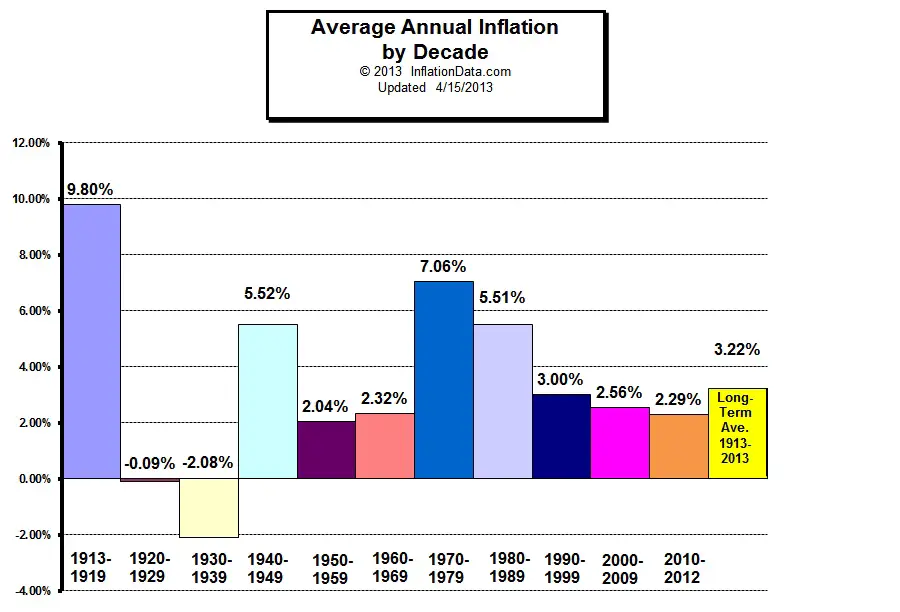
http://inflationdata.com/Inflation/images/charts/Inflation_Trends/inflation_by_decade.jpg
source: InflationData.com

For most of my career - actually, for most of my life, come to think of it - one of the largest economic concerns in the U.S. has been inflation.

However, as the chart above indicates, the inflation I experienced in the 1970's and 1980's was actually more unusual than the norm.  If you assume that the inflation in the 1940's was largely the result of World War II price pressures, it could really be argued that inflation for most of the 20th century really was not a big issue.

Now policymakers seem to be more worried about deflation than inflation. 

The European Central Bank cut interest rates last week (over the objections of the Germans) citing deflationary pressures.  Fed Chairman Bernanke has signaled that he too is worried about the threat of deflation, as did Janet Yellen in her testimony yesterday.

The implications of a sustained period of low or declining prices are too numerous for a short post, but sufficient to say that there is enough reason to consider a deflationary scenario.

Here's an excerpt from a Reuters piece earlier this week:

Deflation alone is not seen as an outright negative for equities, which can still rise if there is moderate growth.

But in such an environment, financial stocks tend to underperform because deflation increases a borrower's real debt burden, contributing to higher non-performing loans and lower net interest margins for banks as the gap between short- and long-term interest rates narrows.

"If we get a deflation psychology beginning to break out in Europe you have to reconsider the relationship between a 'risk' asset and 'non-risk' asset," said Bill O'Neill, chief UK investment strategist at UBS Wealth Management.

"Markets will be focusing on assets that provide nominal guaranteed returns such as government bonds. You would want to be aware of risks in equities, in particular in financials."

http://www.reuters.com/article/2013/11/13/us-investment-deflation-analysis-idUSBRE9AC06720131113

Deflation also would increase the credit risk of corporate bonds, since the cost of repaying debts would be rising in real terms.

Still, I think the jury is still out as to whether prices really are entering a sustained period of flat or negative trends.


Thursday, November 14, 2013

Buying Tech Stocks

I wrote last week about the difficulties of developing a winning investment strategy in technology stocks.  More examples can be found in recent news reports.

The pace of change in tech is, of course, astonishing.  Here for example is an excerpt from an article in this morning's New York Times about the incredible processing power that Amazon.com is now offering on a subscription basis through something they call "Amazon Web Services" (I added the emphasis):

...On Tuesday, a company appearing at the Amazon conference said it had run in 18 hours a project on Amazon’s cloud of computer servers that would have taken 264 years on a single server. 

The project, related to finding better materials for solar panels, cost $33,000, compared with an estimated $68 million to build and run a similar computer just a few years ago. Akin more to conventional supercomputing than {IBM's} Watson’s question-and-answer cognitive computing, the project was the first of several announced at the Amazon conference. 

“It’s now $90 an hour to rent 10,000 computers,” the equivalent of a giant machine that would cost $4.4 million, said Jason Stowe, the chief executive of Cycle Computing, the company that did the Amazon supercomputing exercise, and whose clients include The Hartford, Novartis, and Johnson & Johnson. “Soon smart people will be renting a conference room to do some supercomputing.” 


Little wonder, then, that the most valuable companies in the technology area that have little or no profitability, murky revenue outlooks, yet are offering users capabilities that few thought available just a few years ago (e.g. Twitter).

Still, it is almost mind-boggling to see the young entrepreneurs who started the instant message service Snapchat turn down $3 billion from Facebook.

While Snapchat is hugely popular among millenniums,  the company has no revenue or profits.  Moreover, it is not clear how they will be able to monetize its current popularity:

What business makes no money, has yet to pass its third anniversary and just turned down an offer worth billions of dollars? Snapchat, a social media service run by a pair of 20-somethings who until last month worked out of a beachfront bungalow in Venice, Calif...

The service, started in 2011 by Evan Spiegel, 23, and Bobby Murphy, 25, two former Stanford fraternity brothers, lets users send photo and video messages that disappear after they are viewed. Snapchat quickly gained a reputation as an easy way to send sexually suggestive photos, but it also picked up steam as a fun and easy way to trade photo messages. 

The company has in recent months become one of the most sought-after businesses in the tech industry, getting attention from top Silicon Valley companies and venture capital firms, as well as international technology companies. 


Interestingly, Fortune magazine's technology columnist Dan Primack thinks that Snapchat was right to turn down a multi-billion dollar payday:

Facebook's original offer was said to be for between $1 billion and $2 billion, but today the WSJ is reporting that Zuckerberg later raised the stakes to $3 billion. And was still rebuffed!

At first blush, it seems ridiculous. A pre-revenue company founded less than three years ago turns down a deal that would value it at 3X what either Instagram or Tumblr got...

...Snapchat and its investors seem to believe that this company is the next generation of social networking -- not an add-on to the dominant incumbent. Snapchat is about immediate/disposable communication, not permanent record-keeping...

In other words, Snapchat is providing its users exactly what existing services like Facebook and Twitter and Tumble are not. Not surprisingly, some people close to the company say that Snapchat's depth of engagement is off the charts. Sure the core technology itself is fairly simple. So is Twitter's (TWTR) -- a company that also wasn't monetizing 2.5 years into its existence.

http://finance.fortune.cnn.com/2013/11/13/snapchat-crazy-facebook/?iid=SF_F_River

Meanwhile, back in "old" tcch, companies like IBM, Oracle and Microsoft are trading at multi-decade lows.  Here's JP Morgan strategist Thomas Lee as quoted on CNBC:

{Lee} sees opportunities in low PE, mega-cap tech names like Microsoft, IBM, Cisco Systems, Oracle, EMC, even Hewlett-Packard—saying more than half the group are "under 12 [times earnings]." 

"It reminds of the pharma trade a few years ago. People looked at these low multiples, these cliffs, and thought it wasn't worth buying. And then they were great stocks," he said. 

http://www.cnbc.com/id/101190119

In other words, the current winners in the tech space seem to be inversely correlated with profitability.

Wednesday, November 13, 2013

What's The Next Move for Biotech Stocks?

Investing in biotech stocks is not for the faint of heart.

Not only is the science challenging, but often the best performing stocks make no sense on commonly-used valuation metrics.  Instead, huge price swings occur on the basis of "news flow" of the progress of new innovative drugs and therapies.

As the chart above shows, biotech stocks have been huge winners this year.  Companies like Gilead Sciences and Celgene have nearly doubled in the wake of investor enthusiasm for not only their new drug innovations but also the large potential increase in patient usage.

In addition, biotech stocks are probably the only true growth area left in the health care space. If your mandate is to invest in growth stocks, biotech is essentially the only way to go.

I went to hear biotech analysts Joel Sendek and Steve Willey from the brokerage firm Stifel Nicolaus yesterday. 

Joel and Steve think that there are more gains to come from the biotech space, but future returns will vary widely, as would be expected.

Since most of their stocks do not yet make any money - which is fairly typical in the biotech world - their views are largely based on their opinion of which companies have drugs and procedures in their pipelines that seem promising.

Among their favorites are the large cap stocks that have already had great runs:  Gilead, Celegene and Biogen Idec.  The only large cap biotech stock they don't like is Amgen, which in their view does not have nearly the pipelines as their other large cap brethren.

However, Joel and Steve are true biotech analysts, which means their real passion is finding the next "home run" stock. 

They noted the most portfolio managers take a generalist approach to the biotech space. These managers have either a minimal exposure to biotech or focus their attention on the largest stocks.  This means that the real opportunities are to be found in the stocks in the small and mid-cap space which are not as widely followed.

Still, most of the smaller cap stocks are true "dream" stocks.  Their future price movements are largely predicated on binary events:  if their drugs work, the stocks will soar; if not, potential total loss.

For example, one dream stock they currently touting is called Newlink Genetics Corporation (ticker: NLNK).  Newlink is focusing on novel immunotherapeutic products that could potentially lead to major improvments in cancer therapy.  In trials so far their products have shown great promise, but the final results will not be published until 2015.

Newlink is still losing money, and even if some of their therapies are approved the company will not be profitable until at least 2016.

If they are successful, the stock could go up five times or more before its valuation makes any sense.  And if it fails, well, the stock probably goes to zero.

For me, this is too risky, but I am intrigued by some of their large cap ideas.